Showing posts with label positional words. Show all posts

Tuesday, November 1, 2016

Spooky Houses, Apple Races & Snap Word Power!


As a celebratory Halloween math activity, the kiddos made their annual Spooky Houses!
This year, we used milk cartons as our base (just like with the Gingerbread Houses at Christmas).
We talked about the square and rectangle graham cracker pieces, and students had to roll a die to count how many pieces of candy they added at a time.  They were surprisingly good about sticking to this rule! They panicked when they couldn't find a die.

When the decoration was complete, each student got a candy corn pumpkin to manipulate based on given positional words.  Each house had an icing door, so it was easy to tell where the front/back of the house were.  


Today, we explored gravity with some apple and pumpkin races.  Students manipulated plastic rain gutter slides ($7 for one 10' piece at Lowe's, cut in half) to see what would make the apples reach the ground faster.  Then, students raced an apple and a pumpkin at the same slide height.  They wrote about their conclusions.  They had a BLAST with this activity!


In reading, Spiderman brought us another package teaching us about SNAP WORD POWER! In it, he included Pop Rocks to remind us that we should know Snap Words in a "Snap! Pop!" He taught us that we can check if we're pointing at the correct words based on if we're saying the snap words aloud while we point to them.  Sure, we might not know ALL the words in the story, but if we get to a word we DO know, we should be saying it correctly as we point to it.


Teachers! (And Parents, if you're interested in reading them!) I've scanned copies of all the letters I use from Spiderman in our Readers Have SuperPowers unit! GET YOUR COPY HERE or by clicking the picture below!  You can also find the comic I made HERE and the book for reread power HERE. Enjoy!


Wednesday, September 7, 2016

Math: Circles, Triangles & Positional Words

In math recently, we've been talking about shapes (specifically, circles and triangles) and using positional words to describe where we've found them.  For example, "I see a circle on the wall above the window and next to the color monkeys." (The color monkeys are just that, by the way.  An assortment of monkeys in various colors labeled with the color names.)  Anyway, that circle I was describing is ..... a clock!  

To teach circles and triangles, we read a book about each and reviewed the shape poems.  
Circle: Round and round and round I go, I look like a ball,* I'm Circle Joe. 
Triangle: Count my sides, 1-2-3, Tommy Triangle, that is me!

*This is deceiving. Really a sphere looks like a ball, not a circle, but since we don't introduce spheres yet I think it's okay.

After we looked at the shapes and said their poems, students got a single page to add to a class book with an outline of a circle on the first day and an outline of a triangle on the second day.  Students turned their circles and triangles into something else that naturally has the same shape.  We found out that a circle can be.... a whole pizza, a pumpkin, an eyeball, a bowling ball, a pig's face, and much more!  A triangle can be... a nose, a triangle in music, a jack-o-lantern's eyes, a cat's ears, a slice of pizza, a piece of cake and a wedge of cheese, among other things!

Our class books turned out so cute that I'm going to turn them into digital books, so I'll upload them and post a link here once I've scanned them in.

To introduce positional words, we had Pete the Cat give us a hand.  After reading Pete the Cat The Wheels on the Bus, we reviewed a chart showing what above, below, beside, in front of, behind, and next to mean.  Then students got to manipulate a stuffed Pete around their body according to my instructions.


Students practiced manipulating a paper Pete the Cat around a bus cut-out with a partner for independent practice using positional words.


Friday, October 30, 2015

Making Spooky Graham Houses

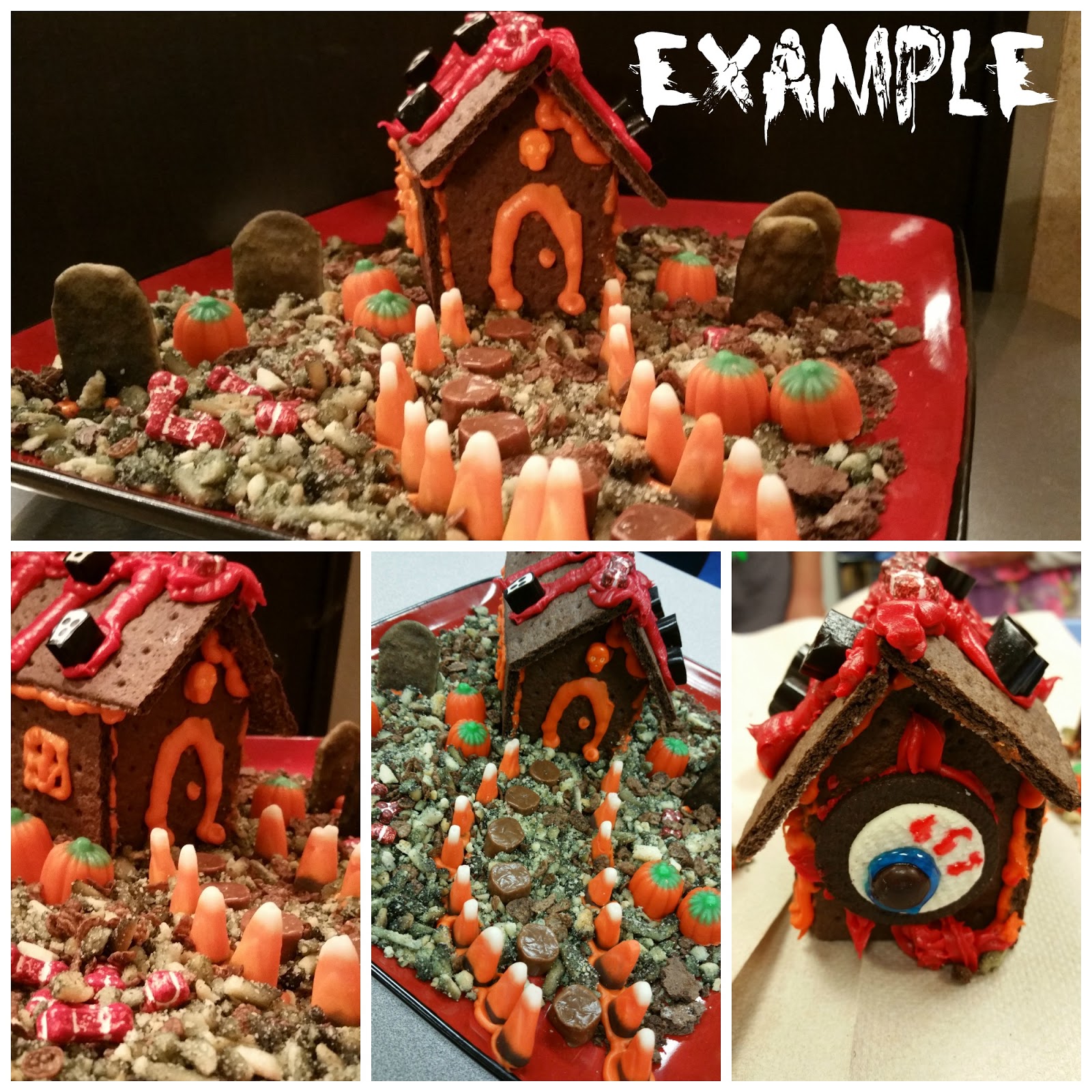
To celebrate Halloween this year, students got to make and decorate Spooky Houses using chocolate graham crackers and a variety of gross, creepy Halloween candy.  We did this during math time, to incorporate counting, shapes, positional words and general strategy & problem solving. 

Here was my example:
I had a good time making this. Thanks, Ms. Ingram, for the Oreo eyeball!

Let me start off with the fact that this could not have been done without parent volunteers! We had six parents come in, in addition to myself and Mrs. Dean. (Sorry to those not pictured with their child. It was hard to get pictures while also helping!)


At Christmas time, I always do gingerbread houses with my students, but those are a bit more structured.  We use milk cartons as the base and I help kiddos create the houses the day before so they have a chance to harden.  There's less freedom in the design.  I wanted these houses to be a bit more of a puzzle for the kids, so they could have the chance to design the houses as they saw fit to be as scary as possible! But trying to put them together freely like this would be impossible without at least one parent per table.  I pre-cut the graham crackers in either a tall, skinny template or a short, wide template, depending on what the kids told me they preferred.  I used this picture as a guide for the short, wide houses and altered slightly for the tall ones:


For the tall ones, I just cut the ends higher up, flipped the sides (same measurement as above) so they'd be tall and skinny and used half a graham cracker each for the roof.  I forgot to show this picture as we were working on them, though (sorry!) so kids kind of put them together however.  I think that worked out better! The variety and creativity was neat to see.  Students chose which color frosting they wanted to use as the glue: red, orange, or black.


Once the pieces were put together, students were able to buy items from the decoration store.  Each student had 100 pennies to spend. 20 of these were loose, plastic pennies and 80 were paper pennies, in strips of 10.  I included this part of the activity because K kiddos are meant to be able to count a collection of up to ten pennies, and I wanted them to count, but in retrospect... this part was a disaster.  It took too long for students to wait in line and spend the pennies, and plastic pennies + frosting do not make a good mix.  So I had to alter this in the midst of creating.


We ended up having a "Flash Sale!" where everything was on sale for 5 cents, but even that didn't get out the decorations fast enough.  I changed it again to say what I was coming around with and how much it cost (e.g., "If you'd like a scoop of dirt to go around the base of your house, it costs 20 cents," or "Gummy worms, 30 cents").  Things we had enough of for each child ended up being free, and the items that had a higher demand cost money.  Basically what I'm saying here is, if you do this activity, rethink how you distribute the decorations.  You could have them count out a certain amount of each decoration, but then everyone has the same decorations so there's less variety. 


Once students finished adding decorations, I gave everyone a non-edible stretchy skeleton to practice positional words.  I asked students to "put the skeleton above the house," "put the skeleton behind the house," etc.  They seemed to have the most trouble with behind. 

All in all, it was a fun day! I had one student say at the end of the day "I wish we had done math tubs today." Mrs. Dean replied, "Instead of these fun houses???" Mrs. Buzzell commented that kids just like routine. At least they enjoy math tubs!  Hopefully they didn't eat the houses all at once. They were full of sugar!


The downside to not using the milk cartons was that, unfortunately, many of the houses fell apart when placed in bags to take home. I still think I'd allow the freedom in design next year, but I may make the houses in two days with frosting 'glue' instead of how we assembled them this year.  


Thursday, September 11, 2014

Math and Literacy Station Rotation

Alright, I finally got the students' pictures printed and set up for both literacy and math (!) stations. Here's a peek at what it looks like:


So students find their picture (by their partner's picture) and can see their literacy station (picture) and their math station (number). Literacy stations are set up around the room, so the picture helps remind students where to go.  Math stations are all in baskets, set up below student bookbags.


The baskets are numbers 0-10 and correlate to the number on the station rotation chart.  If my picture is next to the number 5, I know I need to grab the basket with the 5 on it.  Partnerships are the same in reading and math and students take their math station to the same spot they read during reading workshop. It's a simple way to make sure everyone spreads out, and students remember their spots well ... they picked them!

All of the current math stations focus on counting, subitizing, numeral recognition and formation. 


I try to include books that correlate whenever possible. This station is a count it, say it, write it monster activity where students roll a die, count and put that many googly eyes on their monster and write the number with a dry erase marker. 

Here are some shots of the math stations in action:


Why math stations? Well, when we focus on a concept whole-group (like positional words last week and sorting this week), it's easy to pull students who are struggling with the concept during station time.  All of the station tubs have choices of easy or challenging tasks, so it's easy for kids to get extra practice or an extra challenge at any of them.  But if a child is having trouble counting, even the easy tasks will be difficult.... so I can pull children in a small group and work on a specific task.


Yeah, oops, I wrote "below" twice. =/


Most students picked up positional words pretty quickly after our Positions with Pete lesson; students got a paper cut out of a bus and Pete to take home and practice manipulating them accordingly.  This week, I've found that although sorting is easy for students, ordering the sorted groups from least to greatest has proved challenging. I'm pulling a lot of students for extra help on that.

According to the common core standard, students must "classify objects into given categories; count the number of objects in each category and sort the categories by count." That last part is where we're struggling. If you are a parent, please reinforce this at home (you can sort different types of cereal you happen to have).  If you are another teacher in a common core state, what specific activities do you do to help your students sort by count?  We aren't having any trouble sorting by size....  I think some students got confused, putting small, medium and large things in order instead of least to greatest.